
Showing posts with label words. Show all posts
Showing posts with label words. Show all posts
Thursday, March 19, 2009
Bonus and malus
I love words. I respect people who use them carefully and elegantly. Our excellent local soprano Maria Jette does just that--with insight and humor--in this commentary on the AIG debacle. Check it out!


Saturday, March 22, 2008
Concinnity
con·cin·ni·ty (kən-sĭn'ĭ-tē) n. pl. con·cin·ni·ties
But the opportunity to commit to a "serious" piece of music, the benefits of that stretch for my choir, the chance for them to do something "special," the fun of studying and teaching a piece with so much depth, and finally, the opportunity to collaborate with our neighbor churches (one Methodist, one Episcopal) won out. It's good for us to work together, to build a neighborhood presence, to move out of our own comfort zones a bit...to be a community.
So...the musicians got to work on the Requiem, and the three able presiders worked out the rest of the service. Let me interject here that these three guys are fit together extraordinarily well; it's a happy combination of Fr. Theo's Episcopalian sensitivity to liturgy and quietness, Rev. Cooper's Methodist passion for justice and community, and Pastor Drew's Lutheran groundedness in the Word and lived grace. Their complementarity was evident in their chosen readings and prayers, and music, of which there were three selections, each representing one community's worship practice: a sturdy Lutheran hymn (What wondrous love is this, O my soul?), quietly plaintive Episcopal psalmody (#22 was the order of the night: My God, my God, why have you forsaken me?) and finally, a serenely confident Taizé chant from the Methodist congregation's Friday-night service: Within our darkest night, you kindle the fire that never dies away.
The service was powerful, in a very different way than I'd expected. I got to just sit with all the elements of the service for a while yesterday afternoon, and let them work on me: the Good Friday story of the crucifixion as told in Luke, the text and music of the Requiem, and the "within our darkest night" chant got to me, in a way that opened the possibility of a new experience of Good Friday, and deep gratitude that I get to do this work, especially with as many gifted partners as I've been given.
I've been reading the wonderful memoir The Florist's Daughter, by local author Patricia Hampl. In it, she describes her experience of growing up in St. Paul, the child of an immigrant florist with a true vocation for his work. About him, she writes:
Beauty wasn't simple loveliness for my father. It was the highest token of reality.
It doesn't GET much more real than Good Friday. At the foot of the cross, it's hard to hang on to the illusions and rationalizations that get us through most days. The stark reality of humankind's fearfulness and inventive cruelty is right in front of us. Not much beauty there.
But that's not the only reality present there.
Even on Good Friday, the darkest of days...even within our darkest night, God is at work. God is kindling the fire that never dies away--not even in the moment of Christ's death on the cross.
The gift of music is that we got to sing that light into being last night. Beauty truly became that highest token of reality...and I'm not talking here of perfect musicianship, because it's too easy for that goal to point us toward ego, in the end. It's our job as artists to "chip away all that is not art" (Michelangelo), but that is secondary to our humanity. Our primary task as human beings is to bring our true selves, warts and all, to relationship with God. Music serves as a form of communication within that relationship: honesty, courage and beauty work in concinnity.
There's a moment during the Agnus Dei, for example, when we've been singing a plea for mercy, addressed to the Lamb of God (which certainly takes on added power when sung on Good Friday)...and then, sweetly and softly, a shaft of light breaks that dark moment. The light is sung into existence as the sopranos enter with a sustained note on the word lux: lux aeterna (light eternal)--in other words, the light that never dies away. The light arrives in that musical, human moment, through our openness and effort in tandem with God's grace.
Hampl again:
Only poems and music ... could express the real things, which were the unsayable things.
On Good Friday, the Christian's darkest night, our singers' voices became the instrument of God's grace in space (our sanctuary) and time, measured out in triple meter. The beauty that all these 65-or-so singers, instrumentalists and worship planners and leaders worked so hard to create became, in that moment, both the token and the vehicle of our deepest reality:
God's eternal light that breaks every darkness.
Even the darkness of death.
Thanks be to God.

- Harmony in the arrangement or interarrangement of parts with respect to a whole.
- Studied elegance and facility in style of expression: "He has what one character calls 'the gifts of concinnity and concision,' that deft swipe with a phrase that can be so devastating in children" (Elizabeth Ward).
- An instance of harmonious arrangement or studied elegance and facility.
But the opportunity to commit to a "serious" piece of music, the benefits of that stretch for my choir, the chance for them to do something "special," the fun of studying and teaching a piece with so much depth, and finally, the opportunity to collaborate with our neighbor churches (one Methodist, one Episcopal) won out. It's good for us to work together, to build a neighborhood presence, to move out of our own comfort zones a bit...to be a community.
So...the musicians got to work on the Requiem, and the three able presiders worked out the rest of the service. Let me interject here that these three guys are fit together extraordinarily well; it's a happy combination of Fr. Theo's Episcopalian sensitivity to liturgy and quietness, Rev. Cooper's Methodist passion for justice and community, and Pastor Drew's Lutheran groundedness in the Word and lived grace. Their complementarity was evident in their chosen readings and prayers, and music, of which there were three selections, each representing one community's worship practice: a sturdy Lutheran hymn (What wondrous love is this, O my soul?), quietly plaintive Episcopal psalmody (#22 was the order of the night: My God, my God, why have you forsaken me?) and finally, a serenely confident Taizé chant from the Methodist congregation's Friday-night service: Within our darkest night, you kindle the fire that never dies away.
The service was powerful, in a very different way than I'd expected. I got to just sit with all the elements of the service for a while yesterday afternoon, and let them work on me: the Good Friday story of the crucifixion as told in Luke, the text and music of the Requiem, and the "within our darkest night" chant got to me, in a way that opened the possibility of a new experience of Good Friday, and deep gratitude that I get to do this work, especially with as many gifted partners as I've been given.
I've been reading the wonderful memoir The Florist's Daughter, by local author Patricia Hampl. In it, she describes her experience of growing up in St. Paul, the child of an immigrant florist with a true vocation for his work. About him, she writes:
Beauty wasn't simple loveliness for my father. It was the highest token of reality.
It doesn't GET much more real than Good Friday. At the foot of the cross, it's hard to hang on to the illusions and rationalizations that get us through most days. The stark reality of humankind's fearfulness and inventive cruelty is right in front of us. Not much beauty there.
But that's not the only reality present there.
Even on Good Friday, the darkest of days...even within our darkest night, God is at work. God is kindling the fire that never dies away--not even in the moment of Christ's death on the cross.
The gift of music is that we got to sing that light into being last night. Beauty truly became that highest token of reality...and I'm not talking here of perfect musicianship, because it's too easy for that goal to point us toward ego, in the end. It's our job as artists to "chip away all that is not art" (Michelangelo), but that is secondary to our humanity. Our primary task as human beings is to bring our true selves, warts and all, to relationship with God. Music serves as a form of communication within that relationship: honesty, courage and beauty work in concinnity.
There's a moment during the Agnus Dei, for example, when we've been singing a plea for mercy, addressed to the Lamb of God (which certainly takes on added power when sung on Good Friday)...and then, sweetly and softly, a shaft of light breaks that dark moment. The light is sung into existence as the sopranos enter with a sustained note on the word lux: lux aeterna (light eternal)--in other words, the light that never dies away. The light arrives in that musical, human moment, through our openness and effort in tandem with God's grace.
Hampl again:
Only poems and music ... could express the real things, which were the unsayable things.
On Good Friday, the Christian's darkest night, our singers' voices became the instrument of God's grace in space (our sanctuary) and time, measured out in triple meter. The beauty that all these 65-or-so singers, instrumentalists and worship planners and leaders worked so hard to create became, in that moment, both the token and the vehicle of our deepest reality:
God's eternal light that breaks every darkness.
Even the darkness of death.
Thanks be to God.

Friday, February 22, 2008
Syzygy
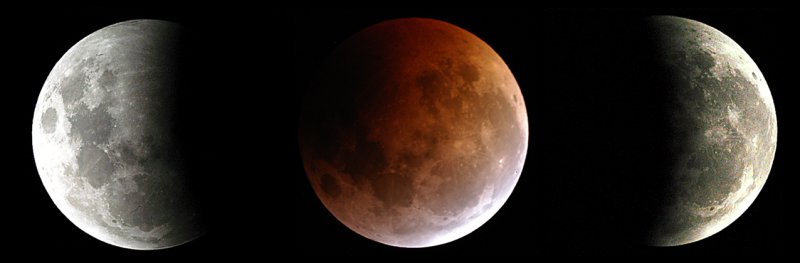 In case you're wondering, that's the word for when the sun, earth and moon lie in a straight line, as they did on Wednesday night with our beautiful lunar eclipse (shout-out to Guillermo Oyhenart, Patagonia, for the stunning photo). It's also a STUPENDOUS Scrabble word. :-)
Sometimes, things align in a way that makes a person sit up and take notice.
My good friend Robin Bragge died two years ago today. I recognize that it's easy to idealize those who have gone on ahead to join the Great Cloud of Witnesses, but I'd like to take a minute today to remember what an exceptional person she was. Robin was one of those rare souls who managed to stay in touch with both raucous joy and gentle wisdom in the face of even the most difficult situations. She had a smile like a beacon; it drew all of us to her and lit up our dark places. She spent her life working on peace and understanding on both micro- and macro- levels. Robin was a fierce drummer (all hail CongaGal!), and her New Years' game parties are the stuff of legend. She was an absolute Scrabble FIEND (that's 27 points on a triple-word-score space).
Robin, we still miss you and love you. Thank you for your warm and sustaining friendship, and for the flock of fledgling peacemakers you left here. I really hope they have a djembe or a set of congas for you up there.
And remember...if you get to play Scrabble with the Big Guy: SYZYGY. 'Cause I think that, even in heaven, we can't help but hope that things will line up just right, even if we are in the dark about it for a little while.
Subscribe to:
Posts (Atom)